I started this blog several months ago, not knowing where it would go. Recently, it seemed that this would be a good opportunity for me to interview some of the interesting people I know – or would like to know – about their lives and their passions.
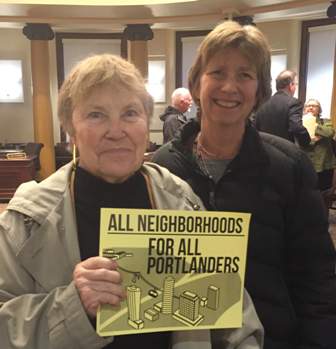
I started with my neighbor and friend, Margaret Bax. This interview focuses on her perspective of Portland housing issues over the years and the role she has played in them.
Throughout the interview, Margaret listed names of many people who were important in her education and in progressive housing policies. I may have left out some: if I did, it’s my fault, not Margaret’s, who emphasizes that Portland’s collaborative nature is what makes change possible.
 Margaret with some of the Zambian families that receive goat milk from the organization she and Casey started.
Portland recently remembered the flood that washed away Vanport – the North Portland community that housed most of Portland’s recently arrived African American residents during the 1940s.
Vanport is most noted for the flood. But it also reminds us of another legacy: lack of affordable housing. Henry Kaiser built Vanport for shipyard workers to reside in at a time when the City of Portland refused to subsidize needed housing.
The struggle to house low-income and working Portlanders has never abated. For much of the last 30 years, Margaret Bax has pushed the city to acknowledge the problem – and to do something about it. With her mentor and friend Gretchen Kafoury, Margaret successfully cajoled, encouraged and nagged the city to recognize the many Portlanders who can’t afford market rate housing.
When Irvington was filled with kids. Margaret grew up in Portland’s Irvington neighborhood when many of the houses were filled by large Catholic families. “The neighborhood was teeming with kids.” Margaret remembers neighborhood softball games pitting Madeleine School students against those from public schools.
“There often weren’t enough public school kids to make a team. Sometimes the Catholic kids had to join the other side to make the teams even. You didn’t really want to change sides, but you did it to have a game.”
Margaret now lives just blocks from the house she was raised in.
“It’s sad to see these great big houses with so few people living in them. They’re more like trophy homes. The emphasis on preserving their historic value is wonderful, but bigger families can’t afford to live here anymore.”
First contact with Portland’s homeless. Margaret studied nursing at Portland Community College and went to work at Holladay Park Hospital, a small facility near Lloyd Center. It was the place where the police would bring homeless people who needed emergency medical care.
Working in the Emergency Room, Margaret treated a lot of street people. But when it came to discharging them, she remembers thinking how absurd were the regular set of instructions for follow-up: “Keep the dressing clean and dry; change it every few days; and visit your regular physician soon. It was impossible for street people to do any of these.”
Within a few years, Margaret started studying political science at Portland State. Her classes, internships and volunteer work led to her public policy career. And her medical background continued to fuel her interest in housing. “It is very hard to stay healthy without a place to live. It’s almost impossible to get well if you are sick and homeless.”
As the first volunteer with Wallace Medical Concern, she visited shelters and SRO’s (single room occupancy dwellings) in downtown Portland. She and Dr. Jim Reuler from the VA outpatient clinic sought out and served people who needed medical care but who were unlikely to go to a clinic or hospital.
“We made house calls to SRO rooms in the old hotels and shelters. Building managers would identify people who were sick or whom they were worried about. We would knock on their door and ask if we could come in and help. Most of the buildings and rooms were pretty funky, but we found these amazing communities where people looked after each other.”
But some memories are shocking: “Like a person lying on a cot, covered with bugs. People in icy cold apartments with no central heat huddled around a small wood stove.” She once walked into a room to find the body of someone who had frozen to death.
Portland pays attention. The surprise election of Mayor Bud Clark in 1984 focused the city’s attention on homelessness and housing needs. “It was the first official recognition that homelessness existed in Portland – and that we could do something about it.”
At the time, Margaret was staff assistant to Gretchen Kafoury, then a Multnomah County commissioner. Bud Clark had a host of allies in city and county government who helped him take the lead on issues of homelessness.
Under Bud’s leadership, a 12-point plan was drafted. Margaret was among many city and county staffers charged with creating an action plan.
Solutions ranged from creating new shelters with partners like Transition Projects to buying buildings for affordable apartments, renovating old buildings, and enforcing health and safety codes. Complementary programs included mental health and addiction services, like the creation of the CHIERS van and Hooper Detox Center.
Most important, Margaret said, “For the first time, the plan gave the community a framework for talking about homelessness.”
Over the years, parts of the plan were completed, including the first safe places for women experiencing homelessness.
Policy maker. When Gretchen earned a seat on Portland City Council in the early 1990s, Margaret moved from Multnomah County with her. Gretchen became the first City Housing Commissioner with the job of coordinating all city housing policy and budgeting. A couple of years later, Margaret accepted a position at the Portland Development Commission. With Gretchen as her ally on City Council, they continued the momentum on housing issues.
Portland had come through an intense period of focusing on homeless. But old problems were replaced by new ones on a massive scale.
Ronald Reagan-era policies resulted in huge reductions to affordable housing funding for lower-income working people. State policies meant formerly institutionalized people with mental illnesses were now on the street, and promised funding for less restrictive housing never materialized. The country’s failure – and the Veterans’ Affairs Department’s inability – to deal with the long-term toll of military service created additional needs for housing and mental health care.
Wages were stagnating, and more and more families just weren’t making it. They were living in cars and church basements. Domestic violence and other ills associated with homelessness were rising.
The City of Portland allocated $30 million in general fund dollars to a new Housing Investment Fund. Gretchen insisted that the first allocation fund housing for large, low-income families, including those below the 30 percent median income level. This was the first time Portland earmarked general fund money for housing for families outside the central city. Other populations housed were seniors and people with disabilities.
Margaret notes the many people who supported this approach and devised policies to make it work, including Steve Rudman, Denny West, Helen Barney and Erik Sten.
“We were most successful when we worked collaboratively with a wide range of community and government partners; non-profit housing and social service providers; for-profit developers; Housing Authority; PDC; the city, the county, the state and the federal government. Some examples are New Columbia, Iris Court, River District and preserving hundreds of very low-income units downtown.”
The other element, Margaret said, was strong political leadership as demonstrated by Gretchen, Bud Clark, Erik Sten and Vera Katz.
Affordable housing in urban renewable districts. In the 1990s, Portland was studying ways to build out large urban parcels that had particular development challenges. Two major areas, the River District (usually called the Pearl District) and North Macadam, were close to downtown. They would be designed for public transit and pedestrian access with the goal of connecting people to jobs without the need for private cars.
But without a lot of effort, the bank and retail clerks, the legal assistants, the teachers and others who make up the bulk of Portland’s work force would be priced out of the new housing. As Housing Policy Manager at the PDC, Margaret wanted to make sure the city lived up to its goals of inclusivity by planning for affordable housing.
During her four years in this role, she was successful in establishing affordable housing goals for every urban renewal district in the city. The targets reflected income levels for the city as a whole.
So how’d that work out? Very well. And poorly.
Affordable housing was one of many negotiating areas for building out the River District. Private developers agreed to increase density over expected market levels; leave pedestrian walkways and meet other city proposals in exchange for streetcar construction, parks and other infrastructure changes.
Developers, led by Hoyt Street Properties, worked willingly with the city. Some of the first projects finished in the area were designated for income levels ranging from 30 to 80 percent of median income. Annual monitoring demonstrates that the River District generally has met its affordable housing goals. Today, the district holds more than 2,000 units of affordable housing.
Then there’s North Macadam. North Macadam is the collection of high rise apartments, condos and Oregon Health Sciences University Buildings between the Willamette River and I-5 just south of downtown. In the center is the east end of the tram that connects to OHSU’s hilltop location.
Both Margaret and Gretchen had been out of public service for years when they refocused on North Macadam. What got their attention was a 2014 notice from the city stating that it wasn’t going to meet its affordable housing goals in the new district. So, the city proposed simply to lower the already-low targets.
 Gretchen, a few days before her death, with Margaret.
“We were appalled that the city would walk away from targets in what was becoming the most desirable neighborhood in the central city. At a time when homelessness was increasing and service sector workers were having to move farther and farther away from their work, it was unconscionable.”
Margaret also was outraged to learn that OHSU had backed out of a deal to build affordable housing on a site in North Macadam that was designated for 400 affordable units. The city also failed to recover at least $2 million of the $6 million it had contributed for building housing on the site.
The city and OHSU built the tram to connect new medical facilities with those on Pill Hill. Margaret saw forsaking affordable housing goals in the area as a giant missed opportunity.
“OHSU is a huge employer.” The hospitals, clinics and research facilities need housekeepers, custodians, nurses’ aides, administrative support staff, clinical technicians and thousands of other workers at all income levels.
Where better than North Macadam to provide housing that these employees can afford?
Gretchen and Margaret, along with other housing advocates, decided it was time for action. Their lobbying and ability to focus media attention on these issues resulted in getting the city to change its position.
Ultimately, the city did not roll back the affordable housing goals, and subsequently it invited proposals for affordable housing in North Macadam. In addition, as a result of their efforts, the city agreed to identify other sites that should hold housing for a range of income levels.
Farewell to a dear friend. One spring day in 2015, Margaret and Gretchen were scheduled to appear before Portland City Council to discuss affordable housing. Just before she left the house, Margaret received an email from Gretchen saying, “Flu. I’m a no go.”
Margaret testified alone, and throughout the day she tried contacting Gretchen, without success.
The next day, Margaret got the news. Gretchen had died of a heart attack at age 72.
One of Gretchen’s last acts on behalf of the city was to remind the mayor and commissioners of their obligations to working people. Affordable housing in North Macadam will be one part of Gretchen’s immense legacy.
Gretchen’s legacy. But Margaret is herself a part of Gretchen’s living legacy.
Margaret’s retired, and she has plenty of ongoing commitments: mentoring members of a goat-raising co-op she and her husband started in Zambia; babysitting great nephews; maintaining a 40-year-old poker game; keeping up close relations with two grown daughters, an extended family and many long-time friends; and working with a group to replace the old Taft Hotel, home to more than 60 extremely poor seniors and people with multiple disabilities.
Housing is never far from her mind. As always, it starts with her neighborhood.
When she and her colleagues pushed for homeowners to be able to build accessory dwelling units throughout the city, including in Northeast Portland, they were thinking about students, seniors and entry-level workers who needed affordable housing in safe neighborhoods. “I didn’t think these would turn into short-term rentals, making them unavailable for people who need housing and further driving up housing prices.”
But she also sees good things coming.
“I am encouraged by current comprehensive plan changes to allow two, three and four-plexes in traditional single family neighborhoods to increase the supply of smaller and more affordable units as well as density in areas with good schools and existing infrastructure.
“I am also feeling more hopeful this last year with the city and county working more closely to address homelessness and housing. The amount of resources being directed at housing has increased significantly, and if they stay the course and maintain commitment, we will see real progress.
“The housing bond being discussed for the fall ballot could make a huge difference. The state also has made significant contributions in terms of dollars and policies to address housing.
“Unfortunately, housing is complicated and requires a long-term view and actions on multiple fronts. That is what makes it so hard. People want one solution that will fix it now. That’s just not possible.”
 clairecommunicationsdotnet