There’s little to add to what’s been said already about the events of this week. All I can say is that I could not be any sadder for this country. And I know this isn’t the last we will see of race-induced murder.
But I want to tell you about an experience I had today that helped offset the grief for me.
In a way, it was sort of a mess. In another way, it was delightful.
I recently started volunteering for SOAR: Sponsored Organized to Assist Refugees. It’s a great volunteer gig. Once a week or so, I get an email from a nice young man named Jacob who doubles as receptionist and volunteer coordinator.
He lists a bunch of tasks that need to be done — mostly driving new refugees to appointments or picking them up at the airport — and asks us if we can take any on.
Today was my third assignment. It was to drive folks from IRCO, a refugee service organization, to a community center to celebrate World Refugee Day.
Well, when you think of it, that’s a weird thing to celebrate, since it’s not exactly a whoo-hooo situation that more than 21 million people are considered refugees, and another 40 million have been physically displaced from their homes.
But here in Portland, IRCO, Soar and other agencies are working hard to welcome families from around the world.
So I was sitting in a classroom at IRCO, where the people waiting for rides were supposed to gather.
In the language department: I have vague memories of high school Spanish, and the other person in the room was a young woman from Burma who speaks English fairly well. Her other language is her native dialect (which I just learned is not Burmese, but I couldn’t tell you what it was).
No one was showing up, until a young man with no English at all came in and, through sign language and loud Ukrainian, inquired about the rides.
We indicated our car keys, and we followed him outside. There we found about 15 people from three continents waiting for rides. Their collective English was “no” in response to the question, “Does anybody speak English?”
Hand gestures are wonderfully useful. I squeezed one large person of unknown origin, one thin Thai and two skinny Ukrainians into my Scion. The other woman was able to get the rest into a van. Apparently, everybody got to the community center OK, because no one was waiting when I came back for a second trip.
So, in my uptight American/Anglo perspective, it was a bit of a fiasco. Why didn’t the system work the way it was supposed to? Did we let anybody down? Doesn’t anybody follow instructions?
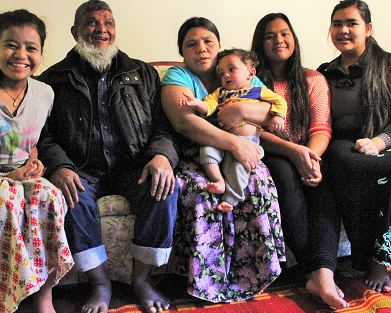
On the other hand — what a hoot. A whole little United Nations of people hanging out together in a parking lot, almost none of them able to talk to each other. And all smiling happily about the possibility of a going to a party with other refugees from dozens of nations.
The man in the front seat even helped me navigate.
So here I am, a person who boasts that she only travels more than three miles from her comfortable home under duress, driving people who have traveled thousands of miles fleeing repression; poverty; possibly incarceration and torture.
I try to imagine what circumstances would force someone to give up everything they’ve known to relocate so far from home — often at great risk — to meet an uncertain future.
In my brief experience with refugee services, things don’t always move efficiently, by American standards. There’s lots of waiting around in long lines or waiting rooms, lots of uncertainty, too few translators and, as we saw, a lot of miscommunication.
Yet to a person, they are grateful: for rides; for English lessons, for help at the immigration office. A couple weeks ago, I watched a young Burmese man try to get through a federal security station. The officers told him in English (and then in Spanish) to empty his pockets. All the time he was being patted down and the officers were pulling coins from his pockets, he smiled graciously, as if this process meant he was a real American.
If you hang out at IRCO, it’s easy to believe that we are a nation of open-hearted people who aren’t angry at our leaders; at each other; at people who don’t look like us or speak our language.
It’s also a great reminder of my grandparents, who came here in 1914 without knowing any English. My sisters, cousins and I carry on their legacy through our family’s shared sense of humor (my grandmother’s) and our ability to sew on a button really well (taught to our fathers by their father, the tailor).
I wish I could have told the the people from Ukraine my grandparents came from there, too. Maybe I will learn one phrase in Ukrainian.
So, yeah, it’s been a crappy week. But my Friday’s been a great one.
Happy World Refugee Day to all of us.
 clairecommunicationsdotnet
Excellent post. You just made my week too.
LikeLike